Solana tool review · Updated 25 October 2026
dEdge Solana wallet analyzer and tracker review
Analyze Solana wallet PnL, closed trades and memecoin trading history with dEdge. Learn how its web reports and Telegram tracking differ from copy trading.
Back to the Solana tools guide
What does dEdge actually do?
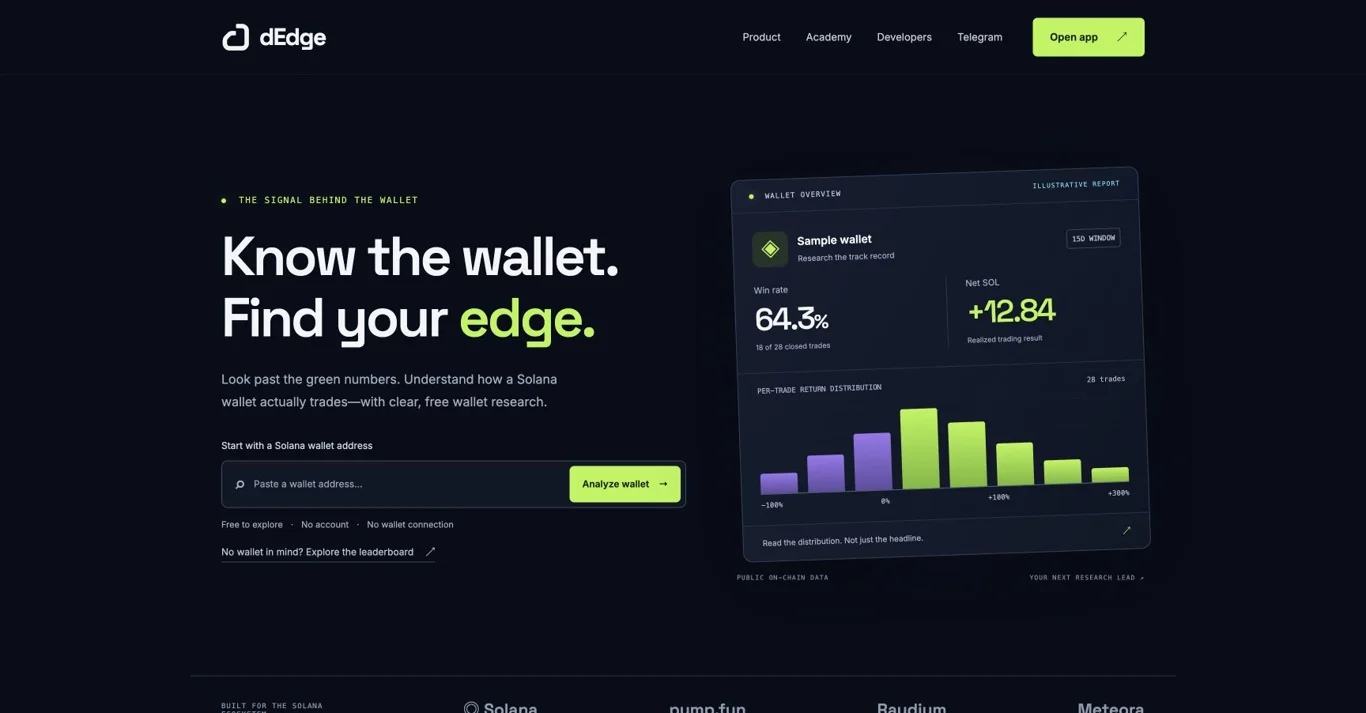
dEdge is a Solana wallet analyzer and tracking tool with a public web app and a Telegram bot. Its purpose is to examine trading history and find wallets worth investigating. It does not execute or automatically copy trades itself.
The distinction matters when choosing a tool. A profitable historical wallet is a research candidate. Turning that candidate into a trade requires a separate execution product, its own funding and its own risk settings.
| Question | Current answer |
|---|---|
| Primary role | Historical Solana wallet analysis and discovery |
| Public access | Free web summaries without an account or wallet connection |
| Surfaces | Web app and Telegram |
| Execution | Third-party tools handle trades and copy trading |
| Tracking | Telegram monitoring and plan-dependent alerts |
Read the result as a distribution
A percentage alone hides the shape of a trading record. Start with the number of closed trades, then look at net SOL and how individual returns are spread. A wallet with many small wins and one severe loss can behave very differently from another wallet with a similar win rate.
The public leaderboard uses a recent 15-day window. Compare like with like: a short burst of activity is not equivalent to a long record, and an old report is not a live signal. The page shows report timestamps so you can keep the observation date attached to your conclusion.
Our assessment: dEdge is most useful as a filter before deeper investigation. It gives you questions to test, rather than a reason to copy the highest number in a table.
Using a memecoin wallet tracker without misreading PnL
For memecoin research, use dEdge to separate a wallet’s realized trading record from the tokens it still holds. A closed-trade result answers a different question from the current value of open positions. Check the report’s definitions before comparing either figure with an explorer balance.
The useful workflow is analysis first, monitoring second: investigate the wallet’s trade count, returns and holding times, then decide whether its next activity deserves an alert. Telegram tracking does not turn a historical result into a live execution instruction.
If you need continuous alerts across a labelled group of wallets, compare the Cielo wallet-tracking workflow. Use dEdge when the primary question is how the candidate wallet has traded.
From a summary to individual trades
The official wallet-analysis guide describes a Last Trades view with trade results, timestamps and links to DEX Screener. That lets you move from an aggregate result to individual entries and exits.
Use those links to inspect whether the apparent result depends on one exceptional trade or a pattern repeated across several tokens. Holding time is another useful distinction. A wallet that enters and exits very quickly may be especially difficult to follow after you see the event.
The Telegram workflow also supports discovery and tracking. Check the plan entitlements before assuming every analysis period, alert or quota is included. The older educational screenshots are explicitly identified by dEdge as historical illustrations, so we do not treat them as a current interface guarantee.
How to use dEdge for a wallet investigation
- Choose a public Solana address. Use the address from a traceable transaction or source. Similar names and social labels are not identity verification.
- Open the public analyzer. A read-only report does not require depositing funds or supplying a private key.
- Record the analysis window. Keep the update time, trade count and result together in your notes.
- Inspect the spread. Compare the typical trade with the outliers. Ask how much of the total depends on a small number of events.
- Check the underlying record. Open relevant chart and explorer links. Transfers and unsold positions need separate interpretation.
- Make a monitoring decision. If the wallet remains interesting, add it to a research watchlist. Do not equate that with enabling automatic execution.
Free access and paid plans
| Plan | Published price | What to check |
|---|---|---|
| Public web | Free | Capacity, report freshness and availability |
| Premium | US$9.99/month or US$79.99 lifetime | Current bot analysis and discovery limits |
| Ultimate | US$19.99/month or US$149.99 lifetime | Current bot limits and trade-close alerts |
These are the prices on dEdge’s current pricing page. The bot’s actual plan entitlement and payment quote control the purchase. Do not infer that a lifetime plan guarantees the product or every future feature will remain available indefinitely.
Start with the public report before paying for more capacity. A subscription is justified by a specific research need, such as more discovery or tracking, rather than by an expectation that paid access creates profitable trades.
Strengths and material limitations
Useful strengths
- A focused wallet-performance workflow.
- A public entry point that does not require signing.
- Trade-level context beyond a headline win rate.
- A path from initial research to ongoing monitoring.
Limits to account for
- Capacity limits and incomplete history can prevent a report.
- Cached results must be interpreted with their timestamp.
- Historical results do not establish future returns.
- Execution costs and copy-trade timing belong to another product.
dEdge, Cielo or a terminal?
Cielo is a useful alternative when your primary task is maintaining an alert feed from an existing watchlist. GMGN combines wallet-led discovery with a broader trading workspace. Axiom and Terminal connect discovery and wallet context to execution.
For transaction verification, use Solscan. For connections between holders of a token, use Bubblemaps. These are complementary questions, not interchangeable measures of a wallet’s skill.
Frequently asked questions
Can dEdge copy trades for me?
No. Its current product explanation places execution and copy trading with third-party tools.
Do I need to connect my wallet?
Not for a public web report. You can research a public address without signing or sharing a private key.
Why is a wallet report missing?
A report may be unavailable because of capacity, rate limits or incomplete history. Missing data is not a zero balance or a negative performance verdict.
Is the highest win-rate wallet the best one to follow?
No. Check the sample size, return distribution, window and underlying trades. An impressive historical result may not be reproducible.
Sources and editorial scope
Checked against first-party material on 25 October 2026. This review covers the documented research workflow. It does not certify returns, data completeness or paid-plan performance.
Affiliate disclosure: we may earn commission through our dEdge link. This does not determine the factual assessment.